Orton Area Guide
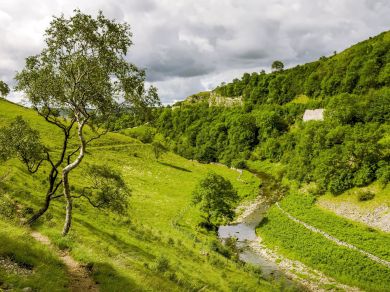
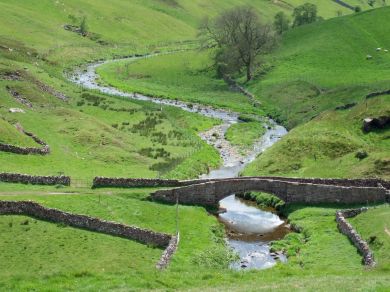
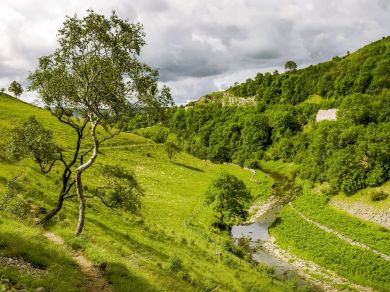
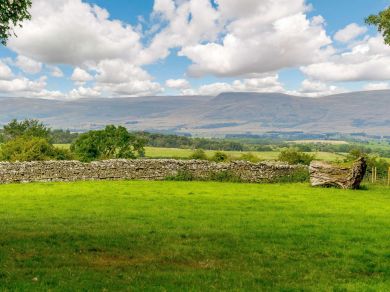
The Upper Eden Valley is surprisingly little known, given that it nestles between the Lake District and the Yorkshire Dales National Park. It is extremely easy to reach, too, with the M6 and A6 running nearby. Its landscape is all its own, dominated by high limestone plateaux at Great Asby and Orton Scars, surreally bare except for rare ferns and wildflowers emerging from fissures in the rocks. The views to east and west are spectacular, especially from the elevated platform of Mallerstang Edge, 2000 feet above sea level.

The Howgills are a small range of mountains bounded by Tebay, Kirkby Stephen and Sedbergh, partly in the Yorkshire Dales National Park (despite still being in Cumbria). They are separated from the Lake District by the River Lune to the west and the Dent fault to the east, and are distinctive for the lack of walls or fences. Familiar to motorway users, the range was described by Wainwright as looking like, ‘a herd of sleeping elephants’; an accurate description of their rounded shapes. Popular walks are The Calf at 676m, Winder at 473m and Randygill Top at 625m. The Howgills are also the site of Cautley Spout, which at 180m is one of England’s highest waterfalls. Cumbria has a great many stone circles and other Neolithic and Bronze Age monuments, and the Upper Eden Valley is no exception. There are cairns across the Scars including the enormous Hollin Stump. It appears to be an ancient burial mound, still standing in parts to 4m. It has been somewhat damaged by ploughing, but is still a striking reminder of an unimaginably ancient human past. Croglam Castle, near Kirkby Stephen, is a prehistoric enclosure with a ditch and bank, with excellent walks in the area.

Gamelands stone circle, at the base of Knott Scar, near Orton, is little known even amongst stone circle aficionados. It has a very large diameter of 42 x 35 metres, and 35 remaining stones. Like many Cumbrian stone circles, it suffered in the past from over-zealous farmers seeking to uproot it, as it is believed it once had many more stones, and they were still standing upright in the historical period. They are now tumbled, standing to a height of a metre or so, made from pink granite from Shap. One of the stones is marbled with glittering quartz, giving a magical effect in low sun. Another historical phenomenon that has affected the appearance of the Upper Eden Valley is a long history of being raided by the Scots
Castle Folds, on Orton Scar, is an acre-and-a-half enclosure designed to protect livestock and keepers in case of attack, now little more than tumbled walls.

Castle Howe, near Tebay, is the earthworks of a medieval motte and bailey castle, constructed for the same reason. The valley has several other castles in a more recognisable state. These include Lammerside Castle, a ruined 12th century pele tower near Kirkby Stephen. Pendragon Castle, near Kirkby Stephen, is another 12th century ruin on the banks of the River Eden. It was built to resist the Scots, but persistent local stories suggest that the site had another castle in the early medieval period, on top of a Roman fort. Of course, the romance of Pendragon Castle is the Arthurian link; it is traditionally the site of the home of Uther Pendragon, Arthur’s father. Uther was supposedly killed here when Saxon attackers poisoned the well.
Brough Castle, a familiar sight from the A66, dates back to 1100. It was built when William Rufus finally wrested northern England from the Scots after the Norman invasion. It was destroyed by a fire in 1521, but restored to life by the local benefactress Lady Anne Clifford in the mid 17th century. It is now heavily ruined again, but is an attractive site for a picnic.

Brougham Castle (not to be confused with Brougham Hall), south of Penrith, is another 12th century ruin, on the site of Verterae, a major Roman fort. It was also temporarily rescued from dereliction by Lady Anne Clifford, but is now wholly ruined. There is an excellent exhibition of Roman tombstones on site.
We meet our friend Lady Anne Clifford again at Appleby Castle, in Appleby-in-Westmorland. Sadly no longer open to the public, Appleby Castle is another very early defensive structure dating to 1092. Kendal Castle is a 12th century ruin overlooking the town. This was the ancestral home of the Parr family, of whom Katherine Parr, sixth wife of Henry V111, was a descendant. The surrounding Castle Hill has super picnicking areas at the top and wooded walks at its foot.
Kendal, home of the infamous mint cake, is a thriving town just a mile south of the Lake District National Park. It has the usual selection of shops, cafes, restaurants, supermarkets, garages and other facilities, much of it sited in attractive 18th century buildings. Its parish church, Holy Trinity, is the largest in Cumbria. Its vernacular layout is dominated by ‘yards’. These were one 150 of these cul-de-sacs, bordered by workplaces and homes. Many have been lost to subsequent town development, but you can still see several including Collin Croft, on Beast Banks. Built as late as 1727, the yard has housed a print works, tobacconists, brass foundry, iron foundry, joinery, coal merchants, bobbin makers and armourer. Abbot Hall Art Gallery offers great value for money. The gallery is based in a grade 1 listed Georgian mansion between the River Kent and Holy Trinity church, and houses a large collection of British art. There is also a gift shop and tea room. The Museum of Lakeland Life is based in Abbot Hall’s former stables, and aims to illustrate the life of an ordinary Cumbrian in times gone by with reconstructed street scenes, costumes and agricultural equipment. There is also an Arthur Ransome room, which has many examples of the famous illustrator’s work, surrounded by his own office furniture. The Museum of Natural History and Archaeology in Kendal is a typical Victorian museum, but it does house a collection of Roman artefacts from Galava (Ambleside) fort

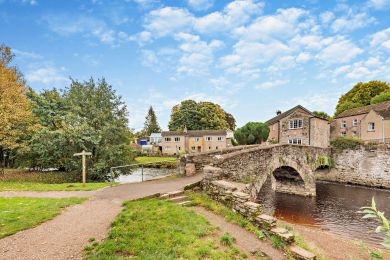
Kirkby Stephen, like many villages in the Upper Eden, was designed to withstand attacks from medieval Scots. It has many narrow passages opening up into large enclosed areas, where cattle would be driven on news of a threat. The village now bears the moniker, ‘Calor Village of the Year’, but it is a practical, rather than pretty, place, with 18th and 19th century buildings. It has a large, 13th century parish church most notable for the ‘Loki stone’, an 8th century carving of a bound Norse devil. Frank’s Bridge, in Kirkby Stephen, is on the old ‘corpse road’ from the surrounding countryside, and was designed with flat areas to rest coffins en route to the parish church. Perhaps it’s this association which drew ghost stories; ‘Jangling Annas’, an escaped prisoner who drowned under the bridge, haunts the bridge, still jangling her chains.
Sedbergh is best known for two things; its famous public school and its recently acquired status of ‘book town’. In common with other appointed ‘book towns’, such as Hay-on-Wye, it has many book dealers specialising in everything from antiquarian to books on textiles. It has a Festival of Books and Drama each September. It is an attractive town with a 12th century St. Andrew’s church, replete with Waring and Gillow pews, looked over by the earthworks of Castlehaw Tower, a medieval motte and bailey which defended the town, yet again, from pesky invading Scots
Appleby-in-Westmorland is Westmorland’s old county town. It’s an attractive place, with Appleby Castle at its head and interesting architecture from the 17th to 20th centuries leading down Boroughgate, its very wide main street. Our old friend Lady Anne Clifford left more marks here, bequeathing the Hospital of St.Anne, a row of attractive 17th century almshouses that accommodate worthy local people to this day. Appleby is perhaps best known for its Horse Fair. Essentially a traditional gypsy gathering, streets and nearby villages are crammed with gypsy caravans – some old, some less so – for the first couple of weeks of June. There are many unofficial horse and trap races in the area as owners seek to prove how good – and how valuable – their horses are. In a ceremony as old as time, horses are washed in the Eden at Sandbanks before being sold to the highest bidder. The town is extremely busy during this period, and the entertainment can become raucous.

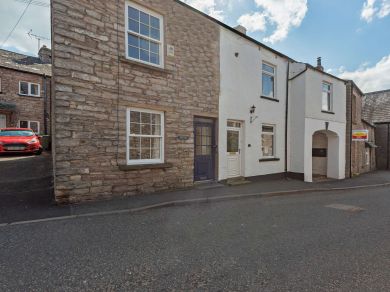
The village of Orton is a small and very pretty place, with 18th century cottages. Wainwright described it accurately as, ‘a place of tranquil beauty and unpretentious appeal’, only improved by the addition of a prestigious farmers’ market and a rather special shop. Orton Farmers’ Market takes place on the second Saturday of each month and is a mecca for foodies from miles around. This is not the sort of market where you stock up on plastic washing-up bowls; each stall is a specialist producer of smoked trout, organic cheese and veg., venison, rare breed beef, home-made puddings and biscuits and hand-made soaps. Kennedy’s Chocolate Shop is a very special chocolatier in Orton. There is a small shop, and a café with a viewing window allowing you to see truffles being made. Their range of chocolates is enormous, and they will pack your personal choice in a selection box – no more fobbing off relatives with the nutty ones! – and if you get withdrawal symptoms when you get home, you can always use their mail order service
Orton is also on Wainwright’s Coast-to-Coast walk, recently trod by Julia Bradbury in a television series. The Walk is a 180mile trek from Robin Hood’s Bay in North Yorkshire to St Bees on the Cumbrian coast.

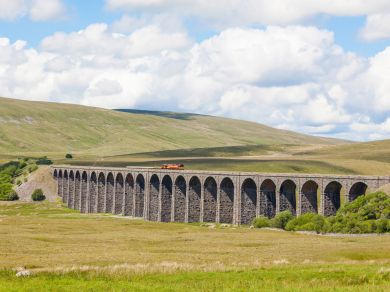
The famous Settle & Carlisle railway runs through the Eden Valley, with daily trains stopping at Appleby and Kirkby Stephen; the perfect opportunity to relax and view this beautiful valley at complete leisure. If you are lucky, you may even get to travel by steam train!
Useful Links
- Have a look at our Review of Outdoor Activities in the Lake District.
- Have a look at things to do Down on the Farm.
- Visit our Review of the Lake District shows
- Cumbrian Wildlife.
- Click here for Dog Friendly pubs in the Lake District.
- Churches in the Lake District.
- Stately Homes in the Lake District.
- A family day at Wetheriggs Animal Centre near Penrith is well worth a visit
- Take a walk to Colonel Lacy's Caves & Long Meg Stone Circle
- Visit Hadrian's Wall and Housestead's Fort.